
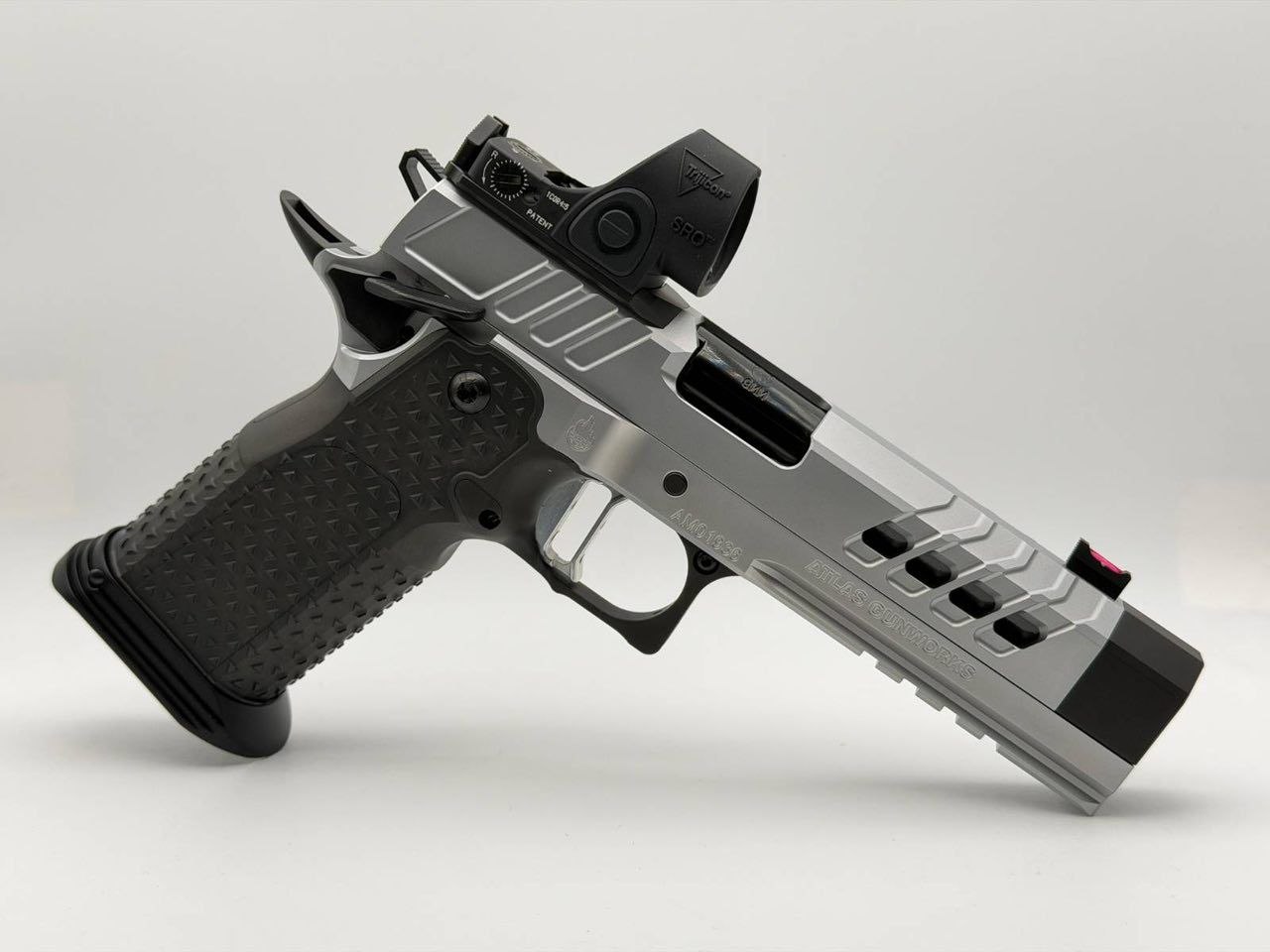
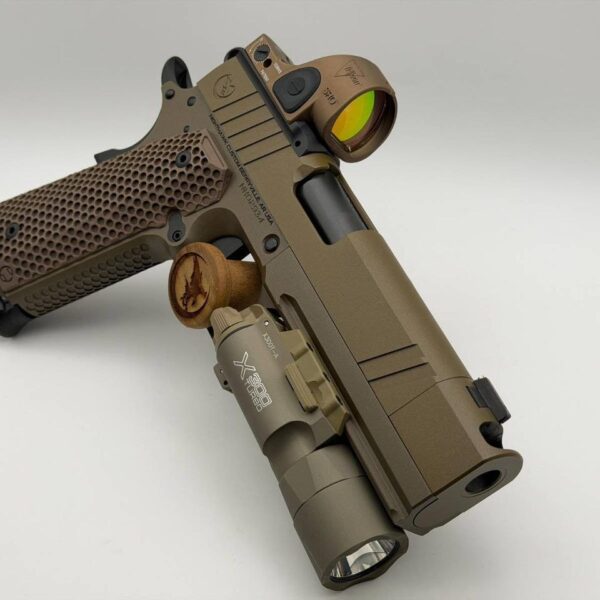

Atlas Gunworks Artemis V3 with Trijicon SRO: Technical Overview
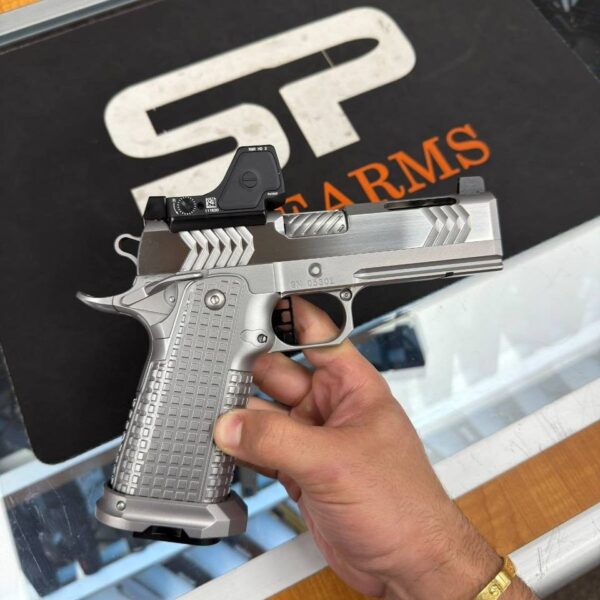
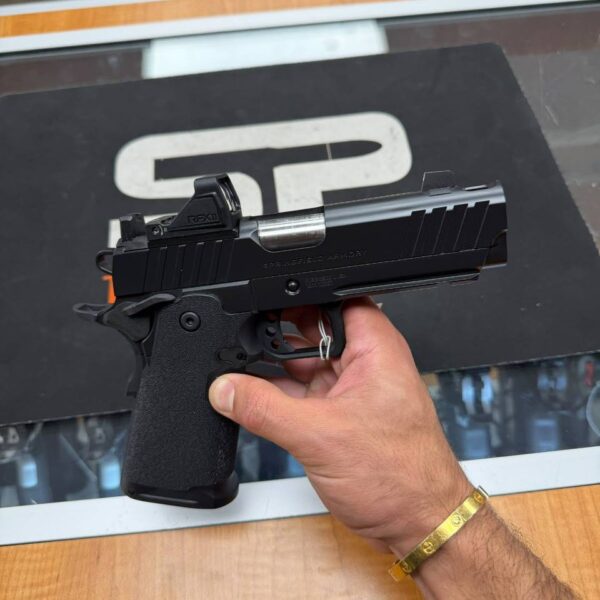
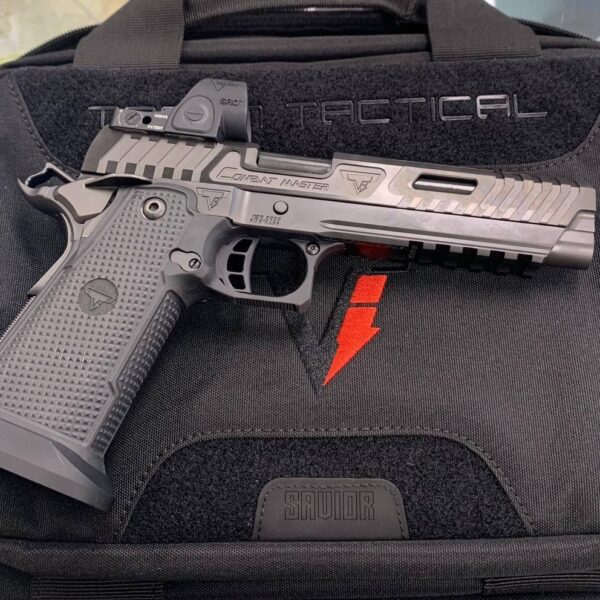
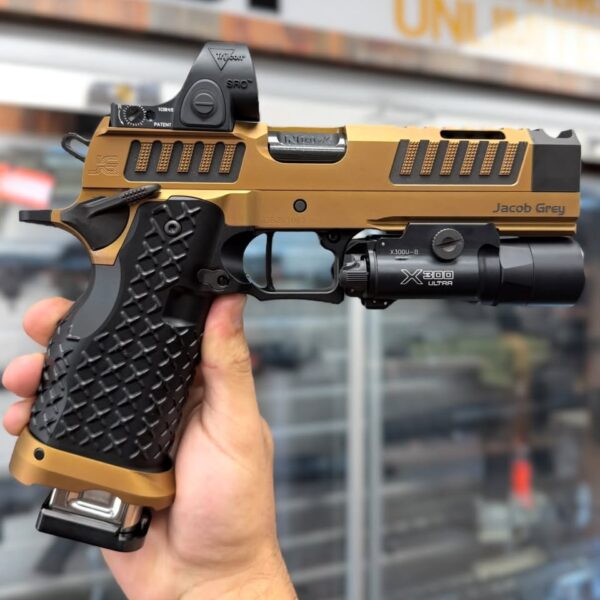
The atlas gunworks artemis v3 with trijicon sro is a competition-oriented semi-automatic pistol designed around the characteristics commonly associated with modern 2011-style platforms. It combines a modular double-stack frame, a match-focused configuration, and components intended to support consistent operation. When paired with a Trijicon SRO miniature reflex sight, the platform adds an optical sighting system designed specifically for handgun applications.
Design and Configuration
The Artemis V3 belongs to a class of pistols that emphasizes mechanical consistency, controllability, and compatibility with competition-oriented equipment. Its overall configuration reflects the priorities of users who place considerable attention on trigger characteristics, sighting systems, ergonomics, and repeatable operation.
The pistol’s frame and controls are arranged around a familiar 2011-style layout. Consequently, users familiar with this platform family may recognize the general relationship between the grip, controls, trigger, and reciprocating slide.
The exact specifications can vary according to configuration and production version. Therefore, official manufacturer documentation should be consulted for authoritative information regarding dimensions, materials, chambering, magazine capacity, and other specifications.
Trijicon SRO Optic
The Trijicon SRO is a compact reflex sight designed for use on handguns and other compatible platforms. Its large viewing window provides an unobstructed sight picture relative to many conventional miniature red-dot designs. In addition, the optic uses a red aiming point that can be adjusted according to the user’s selected configuration.
The SRO is commonly associated with competition and range applications because its design prioritizes a broad field of view and rapid visual acquisition. However, installation requires an appropriate mounting interface, and compatibility should always be confirmed before fitting an optic to a particular firearm.
Ergonomics and Controls
Ergonomics are an important consideration in any handgun evaluation. The Artemis V3’s 2011-style architecture provides a grip configuration that differs from simpler single-stack pistol designs. Furthermore, its controls are positioned to support conventional handgun manipulation.
The trigger system is another defining element of a competition-oriented pistol. A carefully tuned trigger can influence how the firearm feels during operation, although users should not assume that a particular trigger configuration is appropriate for every individual.
Because individual fit and preference vary, hands-on evaluation should be conducted only in a lawful and appropriately supervised environment.

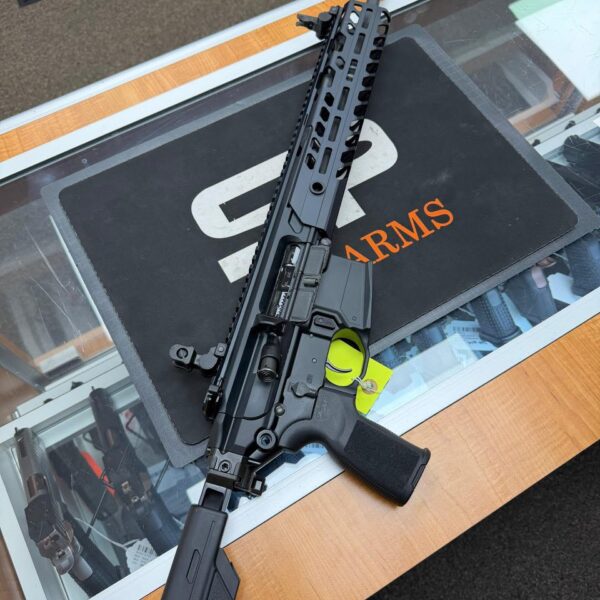
atlas gunworks artemis v3 with trijicon sro
Intended Context
The Artemis V3 is associated primarily with competition-oriented shooting rather than general-purpose sporting equipment. Its configuration reflects an emphasis on repeatability and compatibility with established competition practices.
Similarly, the Trijicon SRO is frequently selected for applications where a miniature reflex sight is appropriate. The combination therefore represents a modern optic-equipped competition handgun configuration.
Nevertheless, equipment should always be selected according to applicable laws, range rules, training requirements, and the user’s legitimate sporting or professional context.
Maintenance and Responsible Handling
Firearms require appropriate maintenance and responsible handling. Before inspecting, transporting, cleaning, or servicing any firearm, users should follow the manufacturer’s instructions and applicable safety procedures.
The firearm should always be treated as loaded until its condition has been safely verified. Moreover, the muzzle should remain pointed in a safe direction, and the trigger should not be contacted unless the user has made the deliberate decision to fire in an appropriate setting.
Optics also require periodic inspection. Mounting hardware, the sighting system, and other components should be checked according to the manufacturer’s instructions. If a component appears damaged or improperly installed, qualified professional assistance should be obtained rather than attempting an uncertain repair.
Overall Summary
The Atlas Gunworks Artemis V3 with a Trijicon SRO represents a competition-focused handgun configuration combining a 2011-style pistol platform with a modern miniature reflex sight. Its design emphasizes factors such as ergonomics, sight presentation, mechanical consistency, and competition-oriented configuration.
However, specifications and configurations can differ between individual examples and production periods. For that reason, official documentation should be treated as the authoritative source for technical specifications.
Most importantly, ownership, transportation, storage, maintenance, and use should comply with all applicable laws and established firearm-safety practices. A qualified instructor or gunsmith can provide appropriate hands-on guidance where necessary.
atlas gunworks artemis v3 with trijicon sro
Atlas Gunworks Artemis V3 with Trijicon SRO: Expanded Technical Overview
The Atlas Gunworks Artemis V3 with a Trijicon SRO represents a modern competition-oriented handgun configuration built around a 2011-style platform and a miniature reflex optic. Rather than viewing the firearm simply as a collection of individual components, it is useful to understand how its major systems relate to one another. The frame, slide, barrel, trigger assembly, grip, controls, magazines, and optic interface all contribute to the overall configuration.
The Artemis name is associated with Atlas Gunworks’ line of competition-oriented pistols. Meanwhile, the Trijicon SRO is a compact red-dot sight designed for handgun applications. When these components are configured together, the result is an optic-equipped pistol intended for environments in which repeatable sight presentation and equipment consistency are important.
Because individual firearms can differ by production configuration, users should distinguish between general platform characteristics and the exact specifications of a particular example. Manufacturer documentation, markings on the firearm, and qualified professional inspection should be used whenever precise information is required.
Platform Background
The 2011-style pistol developed from the broader 1911 design family while introducing a double-stack magazine and a modular approach to the grip and frame. Consequently, a 2011-style pistol can retain familiar characteristics of the older platform while offering a different overall configuration.
The Artemis V3 fits within this broader category. Its design places considerable emphasis on competition-oriented features and mechanical consistency. In practical terms, this means that attention is given to areas such as the trigger system, sighting arrangement, grip geometry, and overall fit between major components.
However, terminology surrounding 2011-style pistols can sometimes create confusion. Not every double-stack 1911-pattern pistol has the same internal architecture, dimensions, component compatibility, or manufacturing standards. Therefore, technical descriptions should be based on the specific firearm rather than assumptions about the platform as a whole.
atlas gunworks artemis v3 with trijicon sro atlas gunworks artemis v3 with trijicon sro atlas gunworks artemis v3 with trijicon sro atlas gunworks artemis v3 with trijicon sro atlas gunworks artemis v3 with trijicon sro atlas gunworks artemis v3 with trijicon sro atlas gunworks artemis v3 with trijicon sro atlas gunworks artemis v3 with trijicon sro
Frame and Grip Architecture
The frame and grip form an important part of the overall handling characteristics of a handgun. On a 2011-style platform, the grip area accommodates a higher-capacity magazine than a traditional single-stack 1911 configuration.
The grip also provides the primary interface between the user and the firearm. Its dimensions, texture, shape, and controls can influence how the pistol feels when held. Nevertheless, perceived ergonomics remain highly individual. A configuration that feels comfortable to one user may feel different to another.
Competition-oriented pistols often receive considerable attention in this area because consistent hand placement can influence repeatability. Even so, users should not interpret ergonomic characteristics as a substitute for proper instruction. Safe handling practices remain essential regardless of the particular grip design.
The frame also supports several operating components, including the trigger mechanism and other controls. As a result, frame construction and component fit are important considerations when evaluating a precision-oriented handgun.
Slide and Barrel System
The slide houses and interfaces with several critical operating components. During operation, it moves relative to the frame and interacts with the barrel and recoil system. The relationship among these components is central to the mechanical operation of a semi-automatic pistol.
Competition-oriented pistols may receive close attention during manufacturing and fitting because consistent mechanical relationships can be important in precision applications. Nevertheless, claims about accuracy, reliability, or service life should be based on documented testing rather than generalized assumptions.
The barrel is another important component. Its dimensions, chambering, construction, and relationship with the slide can vary depending on the specific configuration. Therefore, anyone attempting to identify the exact specifications of an Artemis V3 should consult the firearm’s documentation rather than relying solely on photographs or generalized descriptions.
Professional inspection is particularly important when questions arise concerning barrel condition, component fit, or unusual wear.
atlas gunworks artemis v3 with trijicon sro
Trigger System
The trigger is one of the most noticeable features of a competition-oriented pistol. Trigger characteristics can include factors such as pull weight, travel, reset, and overall feel.
However, these characteristics should be described carefully. A trigger that feels light or short to an experienced competition shooter may not provide the same experience for another user. Furthermore, modifications to a trigger mechanism can affect the safe operation of a firearm.
For that reason, any adjustment or modification should be handled according to the manufacturer’s specifications and, when appropriate, by a qualified gunsmith. Users should never assume that a trigger modification is safe simply because similar modifications are common in a particular shooting discipline.
The trigger also illustrates why mechanical specifications should not be confused with performance guarantees. A particular trigger configuration can contribute to a certain operating feel, but it does not independently determine a user’s accuracy or skill.
Trijicon SRO Overview
The Trijicon SRO is a miniature reflex sight designed for handgun applications. Its large viewing window distinguishes it visually from several smaller enclosed or partially enclosed reflex sights.
A reflex optic projects an illuminated aiming point into the user’s field of view. Instead of aligning a traditional front and rear sight in the conventional manner, the user observes the reticle against the target area.
This arrangement can change the visual process involved in establishing an aiming reference. However, the optic does not eliminate the need for proper training, safe firearm handling, or appropriate environmental awareness.
The SRO is available in configurations that differ in reticle and related specifications. Therefore, the exact optic installed on a particular Artemis should be identified separately rather than assuming that every SRO-equipped configuration is identical.
Optic Mounting Considerations
A handgun optic must be securely and correctly mounted. The interface between the firearm and optic is therefore an important part of the overall system.
Different pistols can use different mounting patterns, plates, cuts, or direct-mount arrangements. Compatibility should always be confirmed using current manufacturer documentation. A visual resemblance between two mounting systems does not establish mechanical compatibility.
Installation also involves considerations such as fastener specifications, mounting surfaces, and manufacturer-approved procedures. Because an incorrectly mounted optic can shift or become loose, professional installation may be appropriate for users who do not have the required expertise.
The optic itself should also be periodically inspected. Signs of movement, damaged hardware, or other abnormalities should be addressed before the firearm is used again.
Sighting System and Visual Presentation
One reason miniature reflex sights are used in competition is their potential to provide a relatively open sight picture. The large window of the SRO can make the aiming point visually prominent under appropriate conditions.
Nevertheless, the benefits of any optical sight depend on proper presentation and training. An optic does not automatically produce a consistent sight picture. Users must still learn how to establish a safe and repeatable position.
Environmental conditions can also influence an optic’s appearance. Bright sunlight, low light, reflections, obstructions, and other factors can affect the visual experience. Consequently, users should understand the limitations of their equipment rather than treating an illuminated reticle as universally superior to conventional sights.
Controls and User Interface
The controls on a 2011-style handgun generally follow a recognizable arrangement, although exact dimensions and configurations vary. Familiarity with a control layout should never be assumed simply because two firearms share the same general platform family.
A responsible user should understand the function of each control before operating the firearm. This includes knowing how the safety system works, how the magazine is retained, and how the firearm’s condition can be verified.
Such familiarity should be developed through appropriate instruction and the manufacturer’s documentation. Guessing about a firearm’s controls can introduce unnecessary risks.
Magazine System
The double-stack architecture associated with 2011-style pistols distinguishes the platform from traditional single-stack 1911 designs. However, magazine compatibility and capacity can vary according to the exact model and configuration.
For that reason, magazine specifications should be verified against the manufacturer’s documentation and the markings on the specific firearm. Generic assumptions about 2011 magazines can be unreliable because different manufacturers and generations may use different dimensions, components, or compatibility standards.
Magazines should also be inspected for damage and excessive wear. A damaged magazine can affect feeding and other aspects of firearm operation. Any component that appears defective should be evaluated by a qualified professional.
Materials and Construction
Modern competition pistols can incorporate a combination of metals, polymers, and other engineered materials. The exact materials used in the Artemis V3 depend on the specific component and production configuration.
Surface treatments can also serve different purposes. Some finishes are intended primarily for corrosion resistance, while others may be selected for durability, appearance, or compatibility with particular manufacturing processes.
It is important not to infer a component’s material solely from its appearance. When technical accuracy matters, manufacturer documentation remains the better source.
Likewise, visible finish quality should not be treated as a complete assessment of mechanical condition. A firearm can appear externally clean while requiring professional inspection of internal components.
Maintenance Considerations
Regular maintenance is an important part of responsible firearm ownership. The exact maintenance schedule should be determined by the manufacturer’s instructions and the conditions in which the firearm is stored or used.
Inspection can include looking for obvious signs of damage, unusual wear, corrosion, loose components, or other abnormalities. However, maintenance should never be performed without first following appropriate firearm-safety procedures.
Users should consult the official manual for disassembly and maintenance procedures rather than relying on generalized instructions intended for another 1911-style firearm. Even when two pistols appear similar, their internal configurations can differ.
Lubrication requirements should likewise be based on manufacturer guidance. Excessive lubricant can attract debris, while insufficient lubrication may contribute to unnecessary wear. The appropriate approach depends on the specific firearm and its operating environment.
Optic Maintenance
The Trijicon SRO also requires appropriate care. Its optical window should be kept clean using manufacturer-approved methods and suitable materials. Abrasive materials or unsuitable cleaning products can damage optical surfaces.
The optic’s mounting system deserves periodic attention as well. Any unexpected movement, damaged hardware, or visible change in alignment should be treated as a reason to stop and investigate the problem.
Battery management is another consideration for electronic optics. Users should follow the manufacturer’s recommendations regarding battery type, installation, storage, and replacement.
A reflex sight should never be treated as infallible. Responsible users should understand the equipment’s operating requirements and maintain an appropriate backup plan consistent with their training and lawful shooting environment.
Competition Context
The Artemis V3’s configuration is closely associated with competition-oriented shooting. In that environment, equipment is often selected according to the rules of a particular division.
Competition rules can change, and equipment that is permitted in one division may be restricted in another. Therefore, anyone participating in organized shooting should consult the current rules of the relevant governing organization.
Equipment configuration can also affect classification. Optics, magazine configuration, compensating equipment, and other modifications may influence which division applies. Consequently, a competition participant should verify the rules before entering an event.
The same principle applies to equipment modifications. A component may be mechanically compatible while still creating a rules issue for a particular competition category.
Accuracy and Consistency
Terms such as “accuracy,” “precision,” and “consistency” are often used interchangeably in product descriptions, although they describe different concepts.
Accuracy generally refers to how closely shots correspond to the intended point of aim, while precision concerns the consistency of repeated results. Both can be influenced by the firearm, ammunition, optic, environmental conditions, and the person operating the firearm.
Accordingly, it would be inappropriate to attribute a particular level of performance solely to the Artemis V3 or the SRO. Meaningful evaluation requires controlled testing and clearly defined conditions.
A technical description should therefore avoid unsupported claims about guaranteed accuracy or performance. Instead, it should identify the design characteristics that may be relevant to a particular application.
Reliability Considerations
Reliability is another area where careful wording is important. A firearm’s operation can be influenced by ammunition, magazines, maintenance, environmental conditions, component wear, and manufacturing tolerances.
Consequently, no responsible technical description should guarantee that a particular firearm will function perfectly under every circumstance.
If a firearm develops an unexpected malfunction, users should follow appropriate safety procedures and seek qualified assistance. Repeated attempts to diagnose or correct a mechanical problem without sufficient expertise can create additional risks.
Storage and Transportation
Responsible storage is a fundamental aspect of firearm ownership. Storage arrangements should prevent unauthorized access while complying with applicable local laws.
The appropriate method depends on the user’s circumstances, legal requirements, and the firearm’s intended environment. Children and unauthorized individuals should never have uncontrolled access to a firearm.
Transportation requirements also vary by jurisdiction. Before transporting a firearm, owners should consult the applicable laws and regulations rather than relying on assumptions based on another country, state, or region.
The same principle applies to international travel. Firearm transportation across borders can involve substantially different legal requirements, permits, declarations, and restrictions.
Legal and Regulatory Considerations
Firearm laws differ considerably between jurisdictions. Requirements can address ownership, registration, licensing, storage, transportation, importation, possession, and use.
Because the Artemis V3 and Trijicon SRO are specific commercial products, their legal status can also depend on the jurisdiction and configuration. A technical article should therefore avoid presenting a single set of legal rules as universally applicable.
Readers should consult the relevant government authorities or qualified legal professionals for current requirements in their jurisdiction. Regulations can also change over time, making current verification especially important.
Responsible Training
Training is an essential part of responsible firearm ownership. Formal instruction can help users develop safe handling habits and understand the operation of their particular firearm.
Training should be appropriate to the user’s experience level and conducted in a lawful, controlled environment. Qualified instructors can also help identify unsafe habits that may not be obvious to an inexperienced user.
Importantly, familiarity with one handgun does not automatically establish familiarity with another. Differences in controls, trigger characteristics, optics, dimensions, and operating systems can matter.
Therefore, users should become familiar with the specific firearm and its manufacturer’s instructions before attempting to operate it.
Product Identification
When documenting an Artemis V3, accurate identification is important. Model names can, serial information where legally appropriate, optic model, and other manufacturer-provided identifiers. Photographs can also assist with documentation, provided that refer to families of products rather than a single configuration, and production versions may differ.
A complete identification record may therefore include the model designation, caliber marking, serial information where legally appropriate, optic model, and other manufacturer-provided identifiers. Photographs can also assist with documentation, provided that sensitive information is handled responsibly.
The same approach applies to the Trijicon SRO. Different versions can have different reticle sizes, mounting arrangements, or other characteristics.
atlas gunworks artemis v3 with trijicon sro atlas gunworks artemis v3 with trijicon sro atlas gunworks artemis v3 with trijicon sro atlas gunworks artemis v3 with trijicon sro atlas gunworks artemis v3 with trijicon sro atlas gunworks artemis v3 with trijicon sro atlas gunworks artemis v3 with trijicon sro atlas gunworks artemis v3 with trijicon sro atlas gunworks artemis v3 with trijicon sro atlas gunworks artemis v3 with trijicon sro atlas gunworks artemis v3 with trijicon sro atlas gunworks artemis v3 with trijicon sro atlas gunworks artemis v3 with trijicon sro atlas gunworks artemis v3 with trijicon sro atlas gunworks artemis v3 with trijicon sro.
Accurate documentation reduces the likelihood of confusing one configuration with another.
Evaluating Technical Claims
Product descriptions sometimes use broad terms such as “match-grade,” “competition-ready,” “precision-built,” or “high-performance.” Such language can be difficult to evaluate without supporting evidence.
A more useful technical description separates objective characteristics from subjective impressions. For example, a description can identify the presence of a reflex optic, a particular platform architecture, or a documented component specification without promising a particular shooting result.
This distinction improves the credibility of the article and helps readers understand which information is verifiable.
Similarly, manufacturer specifications should be distinguished from independent testing. A manufacturer’s stated dimensions or materials represent documented product information, whereas claims about real-world performance require separate evidence.
Final Assessment
The Atlas Gunworks Artemis V3 with Trijicon SRO can be understood as a modern, competition-oriented handgun configuration that combines a 2011-style pistol platform with a miniature reflex optic.
Its principal areas of interest include the 2011-style frame architecture, competition-oriented trigger and control arrangement, double-stack magazine system, and compatibility with an optic-based sighting configuration. The Trijicon SRO adds a large-window reflex sight intended for handgun applications, while the overall configuration reflects contemporary trends in competition equipment.
At the same time, technical specifications should not be confused with guarantees of performance. Individual examples can differ, and factors such as ammunition, maintenance, component condition, training, and environmental conditions can influence real-world results.
atlas gunworks artemis v3 with trijicon sro atlas gunworks artemis v3 with trijicon sro atlas gunworks artemis v3 with trijicon sro atlas gunworks artemis v3 with trijicon sro atlas gunworks artemis v3 with trijicon sro atlas gunworks artemis v3 with trijicon sro atlas gunworks artemis v3 with trijicon sro atlas gunworks artemis v3 with trijicon sro atlas gunworks artemis v3 with trijicon sro atlas gunworks artemis v3 with trijicon sro atlas gunworks artemis v3 with trijicon sro atlas gunworks artemis v3 with trijicon sro atlas gunworks artemis v3 with trijicon sro atlas gunworks artemis v3 with trijicon sro atlas gunworks artemis v3 with trijicon sro.
For anyone documenting or evaluating this configuration, the most reliable approach is to verify the exact model and components against current manufacturer documentation. Furthermore, maintenance should follow, responsible handling is more important than any individual equipment specification. A technically sophisticated firearm still requires appropriate training, secure storage, careful maintenance, and respect for applicable regulations. When questions arise concerning mechanical condition, modifications, or safe the manufacturer’s instructions, while storage, transportation, possession, and use should comply with all applicable laws.
Ultimately, responsible handling is more important than any individual equipment specification. A technically sophisticated firearm still requires appropriate training, secure storage, careful maintenance, and respect for applicable regulations. When questions arise concerning mechanical condition, modifications, or safe operation, qualified professional assistance should be sought rather than relying on assumptions or generalized internet guidance.



Reviews
There are no reviews yet.