Nighthawk Custom SandHawk with Trijicon SRO and FDE X300 — Product Overview
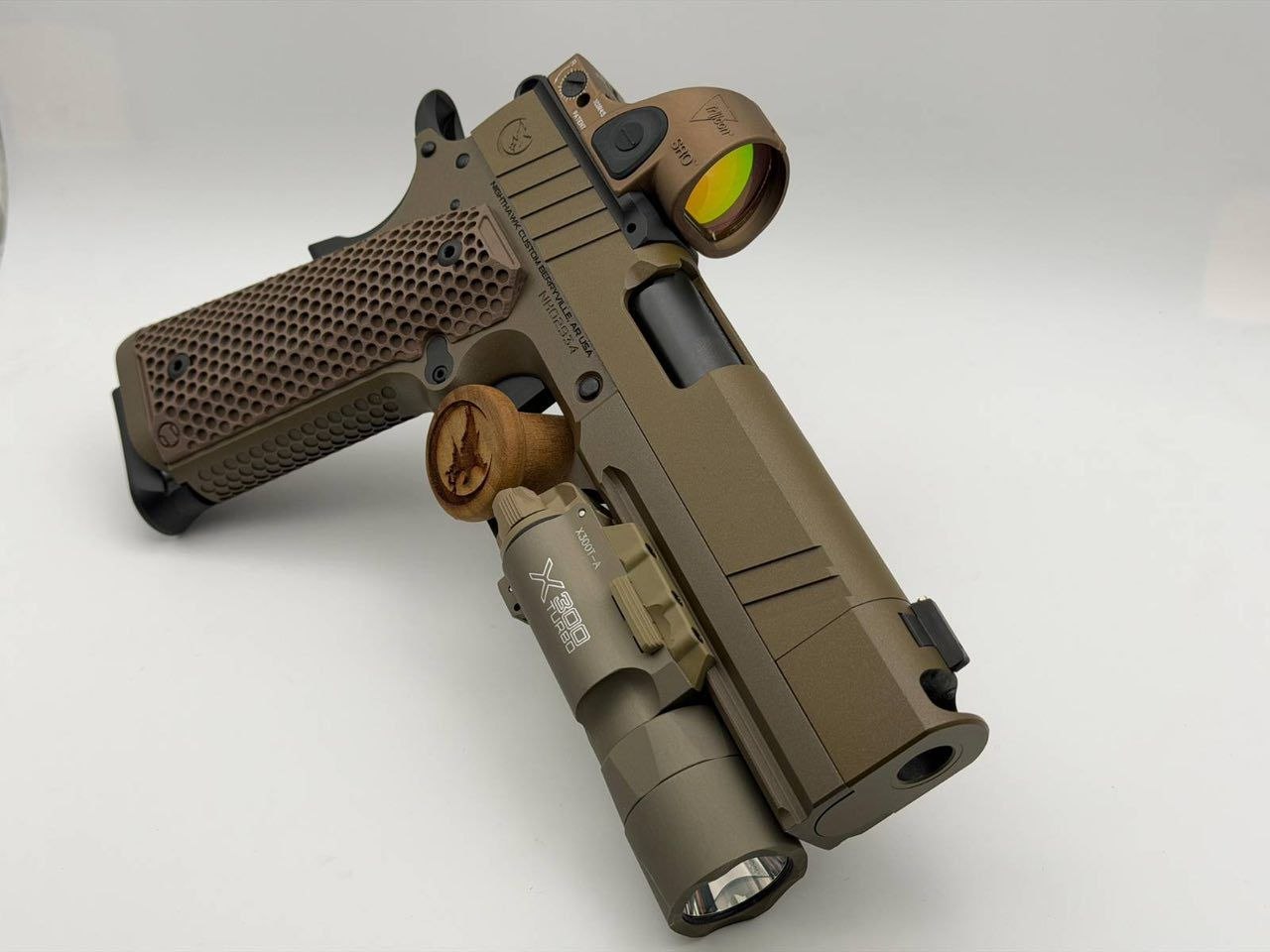
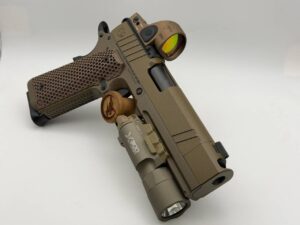
Thenighthawk custom berryville sandhawk with trijicon SRO FDE X300 is a high-end 1911-pattern pistol produced by Nighthawk Custom in Berryville, Arkansas. The SandHawk is distinguished by its Government-size configuration, double-stack architecture, integrated compensator, full-length dust cover, and Flat Dark Earth (FDE) finish. A configuration incorporating a Trijicon SRO red-dot optic and an FDE SureFire X300 adds two recognizable accessories to the platform while maintaining the overall FDE-focused appearance.
Nighthawk Custom describes its manufacturing approach around individual gunsmith craftsmanship. Published information also identifies the company as a Berryville, Arkansas manufacturer and describes the SandHawk as a Government-size double-stack 9mm design.
SandHawk Design
The SandHawk is based on the modern double-stack interpretation of the 1911 platform.
Its Government-size format uses a full-size frame and a 5-inch barrel configuration. Published specifications for the SandHawk identify a 9mm chambering and a 17+1 capacity, although exact specifications should be confirmed for the individual firearm and production configuration.
The model’s visual identity comes from a combination of its FDE finish, full-length dust cover, square trigger guard, integral compensator, and distinctive slide machining.
These characteristics separate the SandHawk from more traditional single-stack 1911 pistols while retaining the recognizable controls and general architecture associated with the platform.
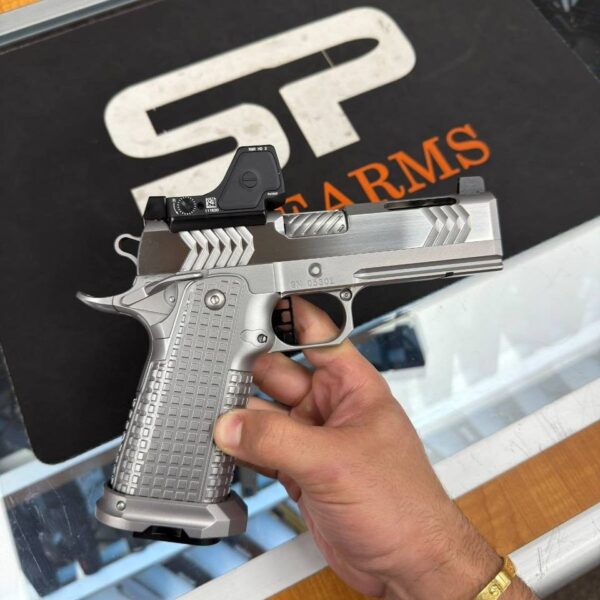
nighthawk custom berryville sandhawk with trijicon SRO FDE X300 nighthawk custom berryville sandhawk with trijicon SRO FDE X300 nighthawk custom berryville sandhawk with trijicon SRO FDE X300 nighthawk custom berryville sandhawk with trijicon SRO FDE X300 nighthawk custom berryville sandhawk with trijicon SRO FDE X300 nighthawk custom berryville sandhawk with trijicon SRO FDE X300.
Berryville Manufacturing
Nighthawk Custom is based in Berryville, Arkansas, a location with a strong association with American custom 1911 manufacturing.
The company’s production philosophy emphasizes individual gunsmith involvement. Published descriptions state that Nighthawk uses fully machined components and hand-fitting as part of its manufacturing process.
This approach is an important part of the SandHawk’s identity.
Rather than describing the pistol simply as a mass-produced 1911 variant, a product overview can place it within Nighthawk’s broader custom-gun manufacturing philosophy.
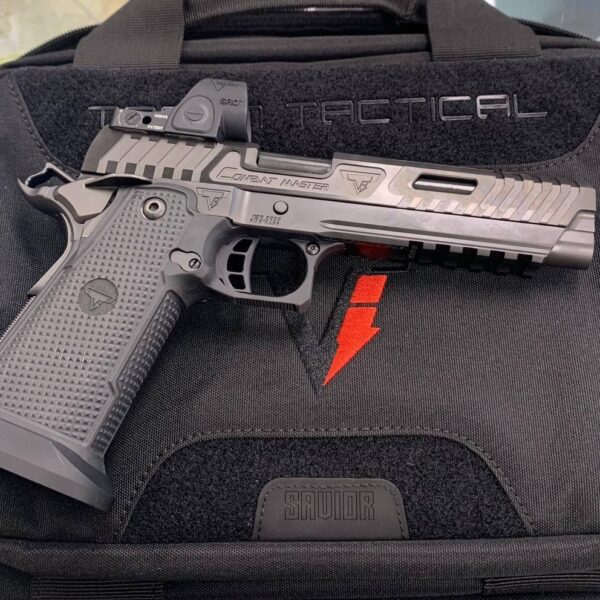
nighthawk custom berryville sandhawk with trijicon SRO FDE X300
FDE Finish
The Flat Dark Earth finish is one of the most recognizable characteristics of the SandHawk.
The FDE exterior creates a subdued two-tone appearance when combined with darker controls and other components.
The finish also provides a visual connection between the pistol and the FDE-colored accessories commonly paired with it.
In the configuration described here, the FDE theme extends to the optic and weapon-mounted light, producing a consistent overall appearance.
The precise finish applied to an individual firearm should nevertheless be verified from the original documentation.
Full-Length Dust Cover
The SandHawk incorporates a full-length dust cover.
This gives the front portion of the frame a substantial appearance and provides the foundation for its accessory rail.
The full-length configuration is visually distinctive compared with traditional 1911 frames, which often use a shorter dust cover.
The design also contributes to the SandHawk’s modern interpretation of the 1911 platform.
Square Trigger Guard
The SandHawk uses a square trigger guard as part of its frame design.
This feature reinforces the model’s contemporary appearance and distinguishes it from the rounded trigger guards commonly associated with classic 1911 configurations.
Together with the full-length dust cover, the square trigger guard creates a recognizable silhouette.
Integrated Compensator
An integral compensator is another defining characteristic of the SandHawk.
Unlike a conventional threaded muzzle device that attaches separately, an integral compensator forms part of the overall barrel-and-slide configuration.
Its presence is one reason the SandHawk has a distinctive front-end profile.
Descriptions of the model frequently identify the integrated compensator as a core feature rather than an incidental accessory.
Slide Design
The SandHawk’s slide incorporates distinctive serration patterns and machining.
Published descriptions identify wide serrations toward the front and rear portions of the slide, contributing both to its appearance and to its recognizable handling surfaces.
The machining is part of the model’s visual character and distinguishes it from more traditional 1911 slides.
As with other custom firearm features, exact machining can vary according to production period or custom configuration.
Optics Configuration
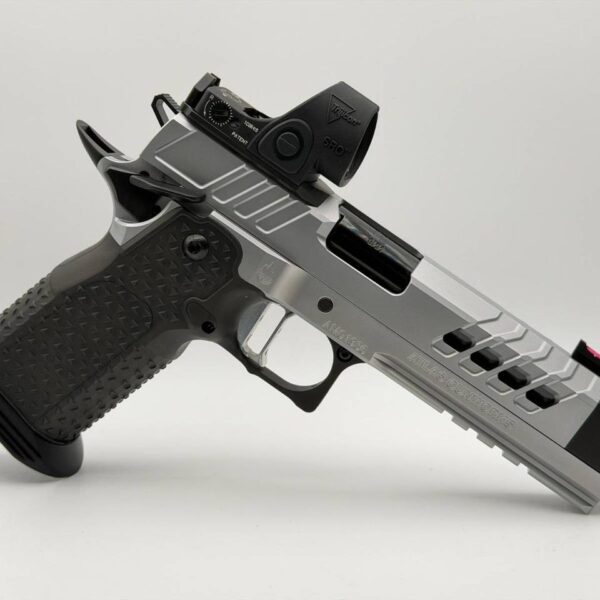
The described configuration includes a Trijicon SRO red-dot optic.
The SRO is a miniature reflex sight designed for handgun applications. Nighthawk’s SandHawk platform can be configured with an optics interface, and published information on Nighthawk’s IOS system describes compatibility with several optic footprints.
The exact mounting arrangement should be confirmed for the individual firearm because optic cuts, plates, and mounting systems can vary.
An SRO-equipped SandHawk should therefore be documented as a particular configuration rather than assuming that every SandHawk leaves the factory with an SRO.
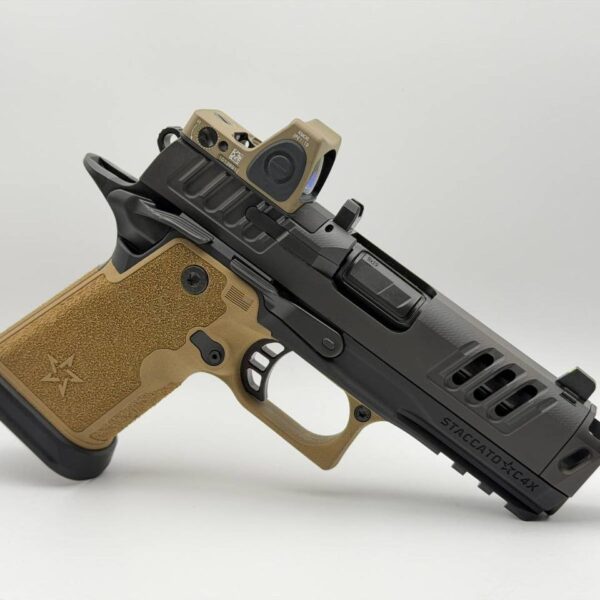
nighthawk custom berryville sandhawk with trijicon SRO FDE X300
Trijicon SRO
The SRO contributes a distinct circular-window appearance to the SandHawk.
Its relatively large viewing window makes the optic immediately recognizable when compared with smaller enclosed or compact reflex sights.
For catalog purposes, the exact SRO variant should be recorded where available, including the model designation and reticle specification.
The optic itself should be documented separately from the firearm because it may have been installed after the pistol’s original manufacture.
FDE Optic Appearance
An FDE or tan-colored SRO creates a coordinated appearance with the SandHawk’s FDE finish.
Color matching between firearm finishes and accessories can vary because different manufacturers use different coating and anodizing processes.
Consequently, two components both described as FDE may not have precisely identical shades.
The combination nevertheless produces a visually consistent configuration.
SureFire X300
The described configuration also includes an FDE SureFire X300 weapon-mounted light.
Published testing of a SandHawk-related Nighthawk configuration has documented a SureFire X300 Ultra as an accessory option.
The X300 series is a full-size pistol-mounted illumination system designed to attach to a compatible accessory rail.
The exact X300 variant should be verified because SureFire has produced multiple versions with different specifications and controls.
FDE X300 Finish
The FDE X300 complements the color of the SandHawk and optic.
This creates a three-component visual theme:
-
FDE SandHawk frame and slide
-
FDE or tan Trijicon SRO
-
FDE SureFire X300
The result is a coordinated configuration that differs visually from a standard black-accessory setup.
Color should be documented as an accessory characteristic rather than treated as evidence of a particular firearm configuration.
Accessory Rail
The SandHawk’s full-length dust cover incorporates an accessory rail.
This provides the mounting interface for compatible equipment such as the X300.
The rail is an integral part of the pistol’s frame and contributes to its modernized appearance.
When documenting the firearm, it is useful to distinguish the integral rail from the separately installed light.
Grip Configuration
The SandHawk’s grip configuration contributes to its double-stack 1911 identity.
Published descriptions identify textured grip surfaces and a modernized frame design.
Grip components can nevertheless vary according to factory configuration or later customization.
If the specific firearm is being cataloged, the exact grip material, color, texture, and manufacturer should be verified rather than assumed from a generic SandHawk specification.
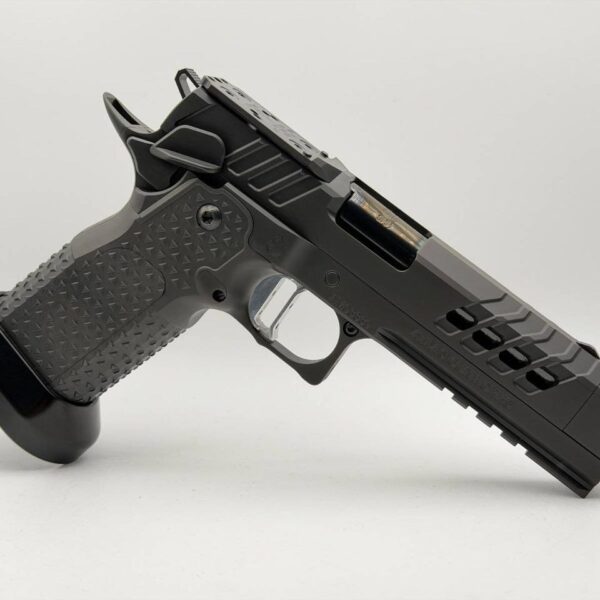
nighthawk custom berryville sandhawk with trijicon SRO FDE X300
Internal and Fitted Components
Nighthawk’s manufacturing philosophy emphasizes individually fitted components.
Published descriptions state that components are machined from billet material and fitted by a gunsmith. The company also identifies its “One Gun, One Gunsmith” approach as part of its production philosophy.
These manufacturing characteristics are relevant to understanding the SandHawk as a custom-built firearm.
However, technical descriptions should avoid turning manufacturing philosophy into unsupported performance guarantees.
Identification
A SandHawk can be documented through a combination of identifying features.
Useful characteristics include: nighthawk custom berryville sandhawk with trijicon SRO FDE X300 nighthawk custom berryville sandhawk with trijicon SRO FDE X300 nighthawk custom berryville sandhawk with trijicon SRO FDE X300 nighthawk custom berryville sandhawk with trijicon SRO FDE X300 nighthawk custom berryville sandhawk with trijicon SRO FDE X300 nighthawk custom berryville sandhawk with trijicon SRO FDE X300 nighthawk custom berryville sandhawk with trijicon SRO FDE X300 nighthawk custom berryville sandhawk with trijicon SRO FDE X300 nighthawk custom berryville sandhawk with trijicon SRO FDE X300
-
Nighthawk Custom markings
-
SandHawk model designation
-
Government-size configuration
-
Double-stack frame
-
FDE finish
-
Full-length dust cover
-
Square trigger guard
-
Integrated compensator
-
Accessory rail
-
Distinctive slide serrations
-
Optics configuration
-
Individual factory markings
The SRO and X300 should be recorded separately as installed accessories.
Factory Configuration Versus Customization
This distinction is particularly important with Nighthawk firearms.
Because Nighthawk offers custom configurations, an individual SandHawk may differ from another example while retaining the same model name.
Furthermore, owners can replace optics, lights, grips, sights, and other components.
Therefore, a photograph showing an SRO and X300 does not necessarily establish that those exact accessories were installed at the factory.
Original invoices, configuration sheets, factory records, and other documentation can help establish provenance.
Product Photography
The SandHawk’s distinctive appearance makes detailed photography useful for identification.
A complete photographic record can show:
-
Overall left and right profiles
-
Slide markings
-
Front-end configuration
-
Optic
-
Accessory light
-
Grip configuration
-
Controls
-
Frame markings
-
Factory identification information
Photographs of the accessories can also document their individual model designations.
Sensitive identifying information should be handled carefully if photographs are published publicly.
Collector Documentation
For collectors, the exact configuration can be an important part of an item’s history.
A record should distinguish between the base SandHawk model and any accessories or modifications.
For example, an inventory record might identify the firearm as a SandHawk and then separately list the Trijicon SRO and SureFire X300.
This prevents accessories from being mistaken for permanent characteristics of the firearm.
Maintenance and Storage
The SandHawk should be maintained according to Nighthawk Custom’s instructions.
The optic and weapon-mounted light should likewise be maintained according to their respective manufacturers’ instructions.
A firearm with electronic accessories has multiple components that require separate attention.
Secure storage is also important. The firearm and accessories should be stored in accordance with applicable laws and manufacturer recommendations and kept inaccessible to unauthorized individuals.
Safety and Legal Considerations
The SandHawk is a firearm and should be handled according to established firearm-safety principles.
It should be treated as loaded until its condition has been personally verified. The muzzle should remain pointed in a safe direction, and unnecessary trigger contact should be avoided.
Firearm laws differ substantially between jurisdictions and can govern ownership, transportation, storage, transfer, and other activities.
This product description cannot establish whether a particular configuration is lawful in a particular location.
Overall Product Character
The Nighthawk Custom SandHawk represents a modern interpretation of the 1911 platform, combining a Government-size double-stack configuration with an integrated compensator, full-length dust cover, accessory rail, and FDE finish.
The addition of a Trijicon SRO and FDE SureFire X300 gives the described example a distinctive accessory configuration.
The result is visually recognizable as a contemporary Nighthawk custom 1911 while retaining the basic design heritage of the traditional platform.
The Nighthawk Custom SandHawk with a Trijicon SRO and FDE X300 is best documented as a specific configuration rather than as a universal specification of every SandHawk.
Nighthawk’s Berryville, Arkansas manufacturing identity and its emphasis on individually fitted custom firearms form an important part of the model’s background. Published specifications identify the SandHawk as a Government-size double-stack 9mm with a 5-inch barrel, integrated compensator, and FDE finish, while exact configurations can vary.
The Trijicon SRO and FDE SureFire X300 should be listed as separate installed accessories. Their presence creates a coordinated FDE appearance while also making the individual configuration visually distinct.
For a professional product record, the strongest documentation combines the firearm’s factory markings and configuration with verified information about the optic and weapon-mounted light.
Manufacturing and Craftsmanship
The Nighthawk Custom SandHawk belongs to the company’s range of custom 1911-pattern firearms. Nighthawk Custom is based in Berryville, Arkansas, and is known for emphasizing gunsmith involvement and individually fitted components.
This manufacturing approach is relevant when documenting the SandHawk because individual examples can contain configuration details that differ from a generic model description. Factory-installed sights, grips, finishes, optic cuts, and other components should therefore be confirmed against the specific firearm’s documentation.
The company’s craftsmanship-oriented approach also means that the model is best understood as a custom firearm rather than simply a standardized production pistol.
Modern 1911 Architecture
The SandHawk retains the recognizable operating architecture associated with the 1911 while incorporating contemporary design elements.
Its double-stack frame, accessory rail, optics compatibility, modern machining, and integrated compensator distinguish it from traditional single-stack 1911 designs.
This combination reflects the broader evolution of the 1911 platform. Contemporary manufacturers have adapted the original design to accommodate modern accessories and different frame configurations while retaining familiar visual and mechanical characteristics.
The SandHawk consequently occupies a space between traditional 1911 aesthetics and contemporary custom-pistol design.
Double-Stack Configuration
One of the most significant identifying features is the double-stack frame.
Traditional 1911 pistols are commonly associated with single-stack magazines and relatively slim grips. A double-stack design uses a wider magazine arrangement and consequently produces a broader grip profile.
This construction is immediately noticeable when the SandHawk is compared with a conventional single-stack Government-size 1911.
For cataloging purposes, the double-stack configuration should be recorded as a core model characteristic rather than an aftermarket modification unless documentation indicates otherwise.
Government-Size Format
The SandHawk uses a Government-size format.
The term “Government” generally refers to the full-size 1911 pattern associated with a five-inch barrel and full-size frame dimensions.
Exact dimensions and specifications should be taken from Nighthawk Custom’s documentation for the particular production configuration.
When creating reference material, it is preferable to distinguish general 1911 terminology from exact manufacturer specifications.
Integrated Compensator
The integrated compensator is among the most distinctive elements of the SandHawk.
Its incorporation into the front-end design gives the pistol a substantially different profile from a conventional 1911 with a standard muzzle.
Because the compensator is integrated into the design, it should be documented as part of the firearm’s factory configuration rather than automatically categorized as a separate accessory.
The exact construction and dimensions should be verified through manufacturer documentation.
Optics Integration
The addition of a Trijicon SRO gives the described configuration a contemporary optic-equipped appearance.
The SRO is a recognizable miniature reflex sight with a circular viewing window. Its presence can make the individual SandHawk easy to distinguish from an iron-sight-only configuration.
However, an optic mounted on a firearm should be treated as a separate component when documenting provenance.
A later owner may replace an optic without changing the underlying firearm.
For that reason, a complete record should identify the SandHawk and the SRO independently.
Trijicon SRO Identification
The exact SRO variant can be documented using its model designation and markings.
Depending on the particular version, the optic can differ in reticle specification and other technical characteristics.
The phrase “Trijicon SRO” alone therefore identifies the general optic family but does not necessarily establish every specification.
Photographs of the optic’s markings can be useful when creating an inventory record.
SureFire X300 Identification
The FDE SureFire X300 is likewise a separate component of the described configuration.
The X300 family includes multiple variants, so an exact product record should use the model designation printed on the light whenever available.
The color can be documented independently from the model.
This is especially useful when a firearm is photographed with accessories that may later be replaced or transferred to another firearm.
Coordinated FDE Configuration
The FDE finish provides a common visual element between the SandHawk and its described accessories.
The combination of an FDE firearm, matching-toned optic, and FDE weapon-mounted light creates a coordinated appearance.
Color matching should nevertheless be described cautiously. Different manufacturers use different finishing processes, and two components both identified as FDE may display slightly different shades.
For archival purposes, photographs provide the most reliable record of the actual appearance of a particular configuration.
Factory and Aftermarket Components
When documenting a custom firearm, it is important to distinguish original factory components from subsequently installed accessories.
The firearm’s serial number and factory documentation establish the identity of the underlying pistol. Accessories such as the SRO and X300 can then be listed separately.
This distinction is particularly important for collector records because the configuration at the time of photography may not be identical to the configuration when the firearm originally left the manufacturer.
Identification Checklist
A detailed reference record can include:
-
Manufacturer
-
Model
-
Serial number, where appropriate and securely documented
-
Chambering
-
Frame configuration
-
Barrel configuration
-
Finish
-
Compensator configuration
-
Optics cut
-
Installed optic
-
Installed weapon-mounted light
-
Grip configuration
-
Factory markings
-
Production documentation
-
Accessory model numbers
These fields allow the firearm itself to be distinguished from subsequently installed equipment.
Documentation and Provenance
Original documentation can be particularly valuable for custom firearms.
Invoices, factory configuration sheets, manuals, certificates, and other manufacturer-provided records may establish how a particular SandHawk was configured when it was produced or transferred.
Such documentation can help resolve questions about whether a particular optic, finish, or other component was factory-installed or added later.
For historical or collector purposes, preserving original documentation alongside the firearm’s record can therefore provide useful provenance.
Careful Description of Performance
A technical product description should avoid turning design characteristics into unsupported performance guarantees.
For example, the presence of an integrated compensator does not by itself establish a particular reduction in recoil, and an optic does not guarantee a particular level of accuracy.
Likewise, custom fitting and hand finishing should be described as manufacturing characteristics rather than guarantees of a specific shooting result.
This approach keeps the description factual and avoids confusing design features with independently measured performance.
Safety and Responsible Ownership
Because the SandHawk is a firearm, technical documentation should be accompanied by appropriate safety context.
The firearm should be handled according to established safety principles and the manufacturer’s instructions. Secure storage is important, particularly where unauthorized access is possible.
The laws governing ownership, transportation, storage, transfer, and use vary by jurisdiction.
Consequently, legal requirements should be checked with the appropriate local authorities rather than inferred from a product description.
Reference Summary
The Nighthawk Custom SandHawk is a contemporary double-stack 1911 configuration associated with Nighthawk Custom’s Berryville, Arkansas manufacturing operation.
Its most recognizable characteristics include its Government-size architecture, double-stack frame, full-length dust cover, accessory rail, distinctive slide machining, integrated compensator, and FDE finish.
The described configuration adds a Trijicon SRO optic and an FDE SureFire X300, creating a visually coordinated setup.
For accurate identification, however, those accessories should be recorded separately from the base firearm. Exact optic and light variants should be established from their individual markings, while factory configuration should be confirmed through Nighthawk documentation when available.
Taken together, the firearm’s factory markings, configuration details, accessories, photographs, and original documentation provide the strongest basis for a reliable product or collector record.
Reviews
There are no reviews yet.