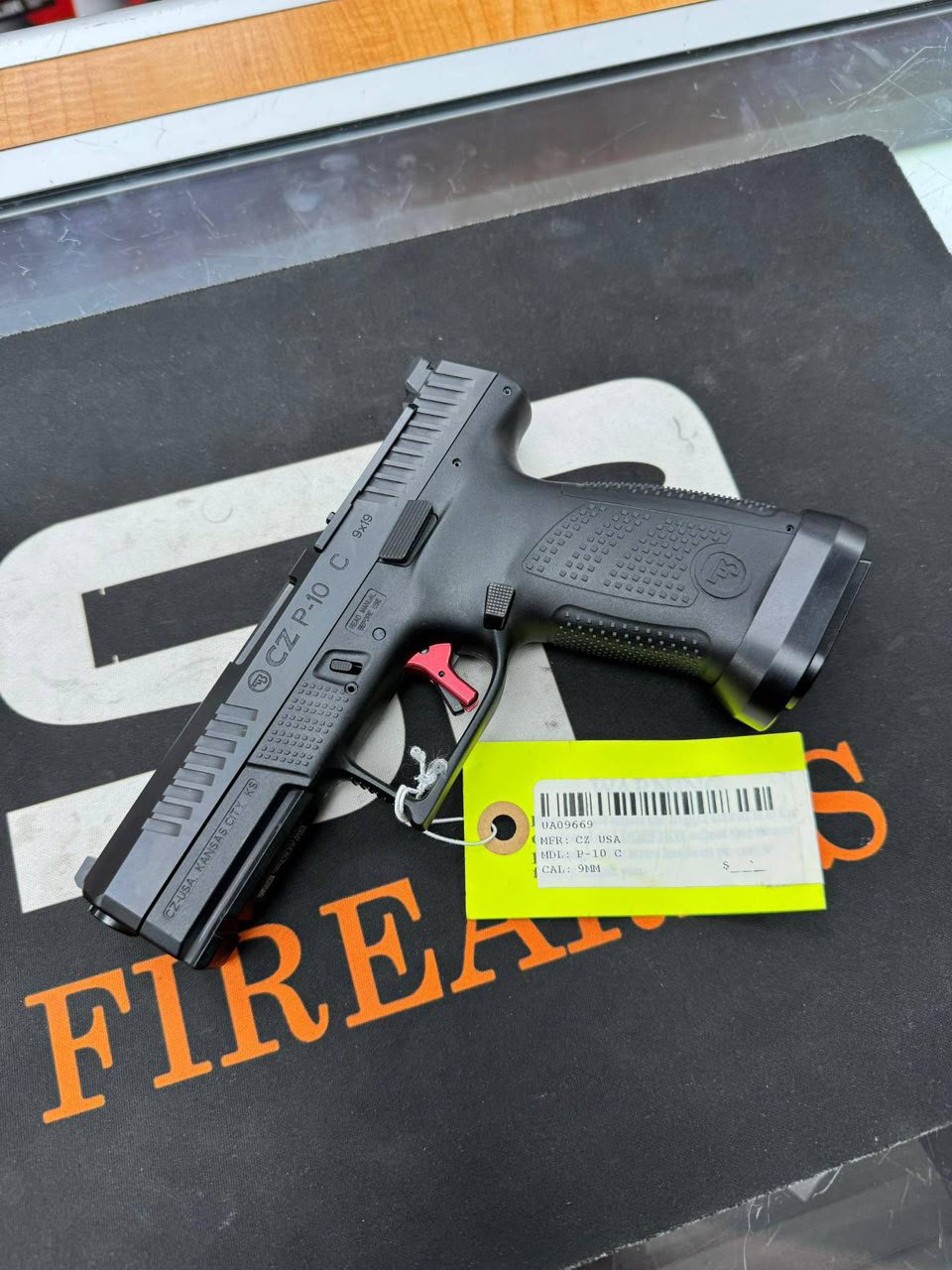
CZ-USA P-10 C Optics-Ready 9mm Pistol
The cz-usa p-10 c optics ready 9mm luga pistol is a compact, striker-fired semiautomatic pistol from CZ. It belongs to the P-10 family, a series known for polymer-frame construction and a design intended to balance compact dimensions with the characteristics of a full-size service pistol.
The optics-ready configuration is designed to accommodate a compatible miniature red-dot sight using the appropriate mounting system. However, exact compatibility depends on the pistol’s production variant, mounting interface, and the manufacturer’s specifications.
Extended product description
Product identity and design philosophy
The CZ P-10 C Optics-Ready combines a compact frame with a striker-fired operating system and a slide prepared for compatible optical sights. It forms part of the broader P-10 family, which includes compact, subcompact, and full-size configurations.
The letter “C” identifies the compact model. This designation helps distinguish it from the P-10 S, which has a smaller overall format, and the P-10 F, which uses a larger frame. Although these models share elements of the same design family, their dimensions and specifications differ.
The optics-ready designation is another important part of the product’s identity. Rather than requiring a conventional slide to be modified after purchase, the optics-ready version incorporates a factory-prepared mounting interface. Consequently, it provides a configuration intended to accommodate a compatible red-dot sight, provided the appropriate mounting components are used.
However, the term “optics-ready” does not mean that an optical sight is necessarily included. Package contents vary by model, SKU, retailer, and market. A product listing should therefore distinguish the pistol’s built-in features from separately supplied accessories.
CZ’s product catalog identifies the P-10 C Optics-Ready as a 9×19mm Luger pistol with a polymer frame, a four-inch barrel, and a standard 15-round magazine configuration for the listed model.
The significance of the 9mm Luger chambering
The CZ P-10 C Optics-Ready is chambered for 9×19mm Luger, a cartridge widely used in contemporary semiautomatic handguns. It is also commonly called 9mm Parabellum or simply 9mm, although precise product documentation should use the designation specified by the manufacturer.
The cartridge’s widespread use has contributed to its presence in sporting, institutional, and civilian handgun markets. Nevertheless, cartridge suitability depends on the firearm’s intended specifications, the ammunition used, and applicable laws.
A product description should not treat the caliber designation as a complete measure of performance. Projectile design, ammunition characteristics, barrel length, and other factors influence how a particular cartridge behaves. Furthermore, results observed with one ammunition type should not automatically be applied to another.
For accurate identification, the firearm’s markings and official documentation should always take precedence over assumptions based on its appearance. Only ammunition explicitly specified as compatible by the manufacturer should be used.
This distinction is particularly important when describing products for an international audience. Terminology and legal requirements may differ between jurisdictions, and a familiar cartridge name does not establish that a firearm or a particular ammunition type is lawful everywhere.
Compact dimensions and external profile
The P-10 C occupies the compact category within the CZ P-10 lineup. Its overall dimensions distinguish it from both smaller subcompact models and larger full-size alternatives.
CZ’s published specifications list an overall length of approximately 7.3 inches, a barrel length of four inches, and a width of approximately 1.3 inches for the optics-ready compact configuration. The published figures may differ slightly between catalog editions and specific variants.
These measurements help establish the pistol’s physical scale. They also provide a consistent basis for comparing model variants in a technical catalog.
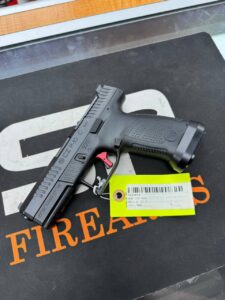
cz-usa p-10 c optics ready 9mm luga pistol
However, measurements alone cannot establish how a firearm will feel to a particular individual. Hand size, grip preferences, and familiarity with the design all influence perceived comfort. Similarly, an unloaded weight figure should not be confused with the total weight of a firearm carrying ammunition or additional accessories.
A clear product description should therefore present dimensions as factual reference information rather than as universal statements about comfort or handling. Where a product’s dimensions matter to the reader, the precise variant should be identified before the measurements are compared.
Polymer frame and construction
The P-10 C uses a polymer frame, a construction choice found in many modern semiautomatic pistols. CZ’s technical documentation identifies the frame material as fiberglass-reinforced polymer in its published P-10 series specifications.
This material combines a polymer base with reinforcing fibers. In engineering applications, reinforcement can improve certain mechanical properties compared with an unreinforced material. The actual characteristics of a finished component, however, depend on its formulation, geometry, and manufacturing process.
The frame supports the grip area and interfaces with the pistol’s other major components. Its shape also influences the external dimensions and the way the product fits into the compact-pistol category.
The slide and barrel use metal construction, while the frame uses polymer. This combination reflects a common approach to modern handgun design, although the exact materials, finishes, and treatments should always be confirmed for the relevant model.
The exterior finish is another point worth documenting. CZ’s catalog lists a nitride finish for the relevant P-10 components. Nevertheless, the appearance and condition of an individual example may vary with age, handling, maintenance, and any subsequent modifications.
For a used firearm, visible scratches or finish wear should be recorded separately from mechanical condition. In the same way, the presence of a clean exterior should not be treated as proof that the internal components are in good condition.
Grip shape and ergonomics
Ergonomics concerns how a product’s shape, dimensions, and controls relate to the person using it. For a handgun, the grip, frame profile, surface texture, and placement of external controls all contribute to its overall design.
The P-10 C has a molded polymer grip that forms part of its compact frame. The manufacturer’s product literature also describes the broader P-10 design in terms of its grip geometry and handling characteristics.
However, ergonomic suitability remains individual. Hand size, finger length, preferred grip shape, and familiarity with a particular design can all influence comfort. Consequently, a product description should avoid presenting one grip profile as universally suitable.
cz-usa p-10 c optics ready 9mm luga pistol
Grip surfaces also deserve factual attention. Their texture, shape, and condition are part of the external design, but they do not establish that a particular user will find the pistol comfortable. Similarly, a modification to the frame or grip may change the product’s original configuration.
For a catalog listing, it is useful to distinguish factory-standard features from aftermarket additions. If the item has replacement components, those changes should be identified where known.
A neutral description can therefore explain the grip’s material and general construction without making unsupported claims about how every person will experience it.
Optics-ready slide design
The optics-ready slide is one of the defining characteristics of this P-10 C variant. CZ describes the OR configuration as having a modified slide intended to accommodate a compatible red-dot sight.
A red-dot sight is an optical aiming device that presents an illuminated aiming point within the viewing window. Unlike conventional iron sights, which require the user to align separate front and rear reference points, a red-dot sight presents the aiming reference through the optic itself.
However, an optics-ready slide does not guarantee compatibility with every red-dot sight on the market. Mounting patterns, adapter plates, screw specifications, and the dimensions of the optic can differ. Therefore, compatibility should be established through the exact pistol documentation and the sight manufacturer’s requirements.
The optics-ready designation also does not necessarily indicate that the pistol ships with an optic. Some packages include only the prepared slide and associated factory components, while other retailer bundles may contain additional accessories.
Furthermore, optical devices have their own maintenance and inspection requirements. Their batteries, lenses, mounting hardware, and overall condition may affect their function. Any installation or adjustment should follow the relevant manufacturers’ instructions and, when necessary, be handled by a qualified professional.
A product listing should clearly state whether an optic is included, whether the mounting hardware is present, and whether the firearm’s configuration has been independently verified.
Sights and visual reference features
The P-10 C Optics-Ready retains a conventional sighting arrangement as part of its factory configuration. CZ’s published specifications identify luminescent sights for the model family, although exact sight details may vary by version or market.
Conventional sights provide a visual reference without relying on an electronic display. A red-dot sight, by comparison, uses an illuminated point within an optical window. These systems differ in design and maintenance requirements, so a product description should identify the actual configuration rather than assume that every optics-ready pistol includes identical equipment.
The condition of the sights is relevant when documenting a particular firearm. Damage, loose components, corrosion, or replacement parts may affect whether the original specification still applies.
Similarly, the term luminescent should not automatically be replaced with tritium or night sights without verifying the exact model. These terms can describe different technologies or configurations.
For that reason, the manufacturer documentation and a direct inspection of the individual item provide the strongest basis for an accurate description.
Trigger system and safety components
The CZ P-10 C uses a striker-fired operating system. In this general design category, the firing mechanism uses a striker rather than the external hammer found on many traditional hammer-fired pistols.
CZ’s documentation identifies several safety components in the P-10 family, including a trigger safety, trigger-bar safety, and firing-pin-block safety.
These components serve different roles within the firearm’s mechanical safety system. Nevertheless, their presence should never be interpreted as making careless handling safe. Mechanical safety devices do not replace proper training, correct storage, or adherence to the manufacturer’s instructions.
The trigger assembly is also a mechanical component whose condition can change through wear, damage, or unauthorized modification. As a result, a used example should not be assumed to retain its original factory condition simply because it has the correct external markings.
Any concerns about trigger behavior, safety mechanisms, or internal components should be referred to a qualified gunsmith. Unapproved alterations can create hazards and may also affect warranty coverage.
For technical documentation, the best approach is to identify the factory-listed safety features without making absolute claims about the condition of a particular pistol.
Magazine configuration and capacity
CZ’s catalog lists a standard 15-round magazine configuration for the P-10 C Optics-Ready 9mm. The exact permitted capacity and supplied magazine configuration may differ according to the SKU, market, and applicable laws.
A magazine stores cartridges and presents them to the pistol’s feeding mechanism. Its design must be compatible with the relevant firearm, and a similar appearance does not establish compatibility between different models.
The magazine supplied with an individual product should therefore be documented independently of the model’s general specifications. For example, a listing may describe a factory-standard configuration while separately recording the number and type of magazines actually included with a used item.
This distinction is useful because product packages can differ across retailers and jurisdictions. Some markets also impose legal limits on magazine capacity.
cz-usa p-10 c optics ready 9mm luga pistol
Accordingly, published capacity figures should be understood as model-reference information rather than an assumption about the exact package being offered. Where a listing concerns a specific firearm, the actual included components and local legal requirements should be confirmed.
Dimensions, weight, and reference specifications
Dimensions provide a consistent way to identify and compare products. For the P-10 C Optics-Ready, CZ’s published series information lists the following approximate reference measurements.
|
Specification |
Reference value |
|---|---|
|
Caliber |
9×19mm Luger |
|
Operating system |
Striker-fired, semiautomatic |
|
Barrel length |
4 inches (102 mm) |
|
Overall length |
Approximately 7.3 inches (187 mm) |
|
Width |
Approximately 1.3 inches (32 mm) |
|
Weight with empty magazine |
Approximately 740 g (26.1 oz) |
|
Standard magazine capacity |
15 rounds for the listed OR model |
|
Frame material |
Fiberglass-reinforced polymer |
|
Slide finish |
Nitride, as listed in the manufacturer’s catalog |
|
Sights |
Luminescent, subject to variant verification |
|
Safety features |
Trigger safety, trigger-bar safety, firing-pin-block safety |
These figures should be treated as reference specifications, not as a guarantee that every product sold under a similar name is identical. Regional configurations and newer variants can differ.
The weight figure is especially important to interpret correctly. A measurement taken with an empty magazine is not the same as the total weight of a loaded firearm or a firearm fitted with additional accessories.
Likewise, the dimensions of a separately packaged optic or other accessory should not be added to the manufacturer’s standard dimensions without clearly explaining the measurement method.
Differences between related P-10 models
The P-10 C is one member of a wider product family. Understanding the distinctions between variants helps prevent specification errors in catalogs and product descriptions.
The P-10 S is the subcompact member of the lineup, while the P-10 F is the full-size model. The P-10 C occupies the compact category between them. CZ also lists optics-ready and suppressor-ready configurations, which should be distinguished from the standard compact model.
An optics-ready model has a slide prepared for a compatible optical sight. A suppressor-ready configuration may include additional features, such as an extended threaded barrel, that are not part of the standard optics-ready version.
cz-usa p-10 c optics ready 9mm luga pistol cz-usa p-10 c optics ready 9mm luga pistol cz-usa p-10 c optics ready 9mm luga pistol cz-usa p-10 c optics ready 9mm luga pistol cz-usa p-10 c optics ready 9mm luga pistolcz-usa p-10 c optics ready 9mm luga pistol cz-usa p-10 c optics ready 9mm luga pistol cz-usa p-10 c optics ready 9mm luga pistol cz-usa p-10 c optics ready 9mm luga pistol cz-usa p-10 c optics ready 9mm luga pistol cz-usa p-10 c optics ready 9mm luga pistol cz-usa p-10 c optics ready 9mm luga pistol cz-usa p-10 c optics ready 9mm luga pistol cz-usa p-10 c optics ready 9mm luga pistol cz-usa p-10 c optics ready 9mm luga pistol.
These labels are not interchangeable. In particular, a product described as “P-10 C Optics-Ready” should not automatically be assigned the dimensions or features of a P-10 C Optics-Ready Suppressor-Ready model.
A catalog editor should verify the exact product code, markings, barrel configuration, sights, and supplied accessories before finalizing the description.
Maintenance, inspection, and condition reporting
The maintenance requirements for a firearm should be established through the manufacturer’s documentation. General descriptions can explain the importance of maintenance, but they cannot replace the specific instructions supplied for the product.
A firearm’s condition may be affected by age, storage, use, corrosion, and previous repairs. Accordingly, a used P-10 C should be described according to the evidence available rather than assumptions about how well it has been maintained.
A condition report can separate visible observations from professional mechanical findings. For example, the exterior finish may show wear even when no mechanical issue has been identified. Conversely, a visually clean firearm may still require an internal inspection.
If the firearm has unknown history, visible damage, or evidence of unauthorized modifications, it should be referred to a qualified gunsmith before use.
Replacement components and accessories should also be documented where relevant. This information helps readers understand whether the item remains in its factory configuration.
Safe storage and responsible handling
Safe storage is a fundamental part of responsible firearm ownership. A compact design or a factory-installed safety mechanism does not eliminate the need for careful handling and secure storage.
The firearm should be secured against unauthorized access, particularly in households where children or other inexperienced individuals may be present. Appropriate locked storage and compliance with local laws help reduce the risk of accidents and unauthorized use.
A firearm should be treated as loaded until its condition has been safely established. Handling should follow established safety rules, and anyone unfamiliar with the model should seek qualified instruction.
A product description should not imply that the firearm’s mechanical safety features replace safe handling practices. Rather, the safety mechanisms are elements of the design that operate alongside the owner’s responsibility to follow the manufacturer’s instructions.
Transportation and possession laws can also vary considerably between jurisdictions. A specification sheet does not establish legal permission to possess, carry, import, or transport a particular firearm.
Accessories and package contents
Accessories supplied with the P-10 C Optics-Ready may vary according to the retailer and product code. Therefore, the contents of a particular package should be documented separately from the manufacturer’s description of the pistol itself.
Potential package items may include magazines, a storage case, documentation, locking equipment, or other manufacturer-supplied components, depending on the exact product and market. These items should not be represented as included unless the seller has confirmed their presence.
An optical sight should also be listed separately if it is supplied as part of a retailer bundle rather than the standard factory package. The same principle applies to holsters, replacement sights, and other aftermarket accessories.
For a used firearm, the listing should state which original items remain available and identify any known substitutions. This approach reduces ambiguity and makes the description more useful as a record of the actual product.
Product identity and documentation standards
Accurate product identification is especially important when several closely related variants share the same family name. A single incorrect specification can make a catalog entry confusing or misleading.
The model designation, caliber, product code, and factory markings provide the foundation for an accurate record. Technical details should then be checked against the corresponding manufacturer’s documentation.
Where a specification remains uncertain, the description should say so rather than filling the gap with a figure from a different model. This is particularly relevant to magazine capacity, dimensions, sight configuration, and optics compatibility.
cz-usa p-10 c optics ready 9mm luga pistol cz-usa p-10 c optics ready 9mm luga pistol cz-usa p-10 c optics ready 9mm luga pistol cz-usa p-10 c optics ready 9mm luga pistol cz-usa p-10 c optics ready 9mm luga pistol cz-usa p-10 c optics ready 9mm luga pistol cz-usa p-10 c optics ready 9mm luga pistol cz-usa p-10 c optics ready 9mm luga pistol cz-usa p-10 c optics ready 9mm luga pistol cz-usa p-10 c optics ready 9mm luga pistol cz-usa p-10 c optics ready 9mm luga pistol cz-usa p-10 c optics ready 9mm luga pistol cz-usa p-10 c optics ready 9mm luga pistol cz-usa p-10 c optics ready 9mm luga pistol cz-usa p-10 c optics ready 9mm luga pistol.
Photographs can help document the external appearance, but they do not independently verify internal specifications or mechanical condition. Consequently, image captions should not claim more than the photographs establish.
These standards benefit catalog editors, retailers, collectors, and readers alike. They encourage consistency while reducing the likelihood that information from the standard P-10 C, the optics-ready version, and the suppressor-ready variant will be combined incorrectly.
Conclusion
The CZ P-10 C Optics-Ready 9mm is a compact, striker-fired semiautomatic pistol distinguished by its polymer frame, four-inch barrel, and factory-prepared slide for compatible optical sights.
Its place within the broader P-10 family makes precise model identification particularly important. Although the compact, subcompact, and full-size variants share a common product lineage, they differ in dimensions and configurations.
For a reliable product listing, verified manufacturer specifications should be combined with an accurate description of the individual item’s condition and included accessories. Optics compatibility, magazine configuration, and model-specific safety information should be confirmed rather than inferred.
Finally, safe storage, responsible handling, and compliance with applicable laws remain essential considerations. A well-written description can communicate the product’s identity and construction clearly while distinguishing factual specifications from assumptions and promotional claims.


Reviews
There are no reviews yet.