

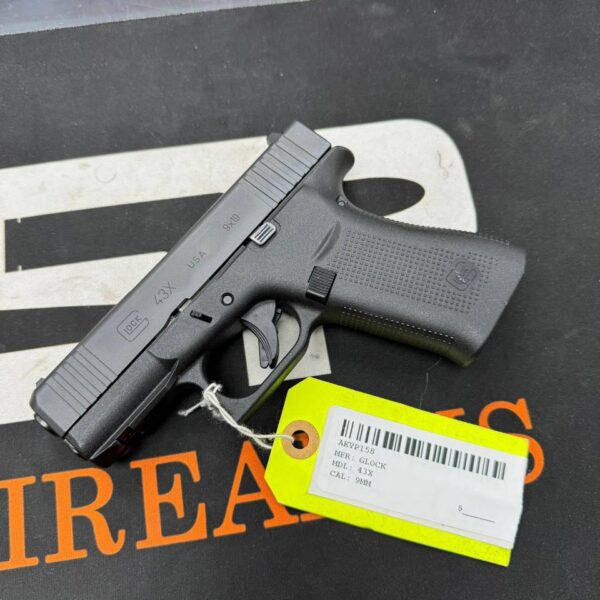

Glock 23 Gen 3 .40 Caliber Safe Action Pistol: Product Overview
The glock 23 pistol g23 gen 3 .40 caliber safe action is a compact, semi-automatic handgun manufactured by GLOCK. Chambered in .40 S&W, it combines a polymer frame, a striker-fired operating system, and the manufacturer’s Safe Action safety system. The third-generation model features a textured grip, finger grooves, and an accessory rail.
Glock 23 Gen 3 .40 Caliber Safe Action Pistol: Extended Product Description
Introduction to the Glock 23 Gen 3
The Glock 23 Gen 3 is a compact, semi-automatic pistol chambered in .40 Smith & Wesson (.40 S&W). Manufactured by Glock, it belongs to a family of polymer-framed handguns known for their striker-fired operating systems and integrated mechanical safety features.
The third-generation Glock 23 combines a relatively compact frame with the characteristics of the .40 S&W cartridge. Furthermore, its familiar grip profile, straightforward external design, and Safe Action system distinguish it within the company’s product range.
The model is often discussed in comparison with the Glock 19, which shares a similar overall format but uses 9×19 mm ammunition. Although the two pistols have comparable general dimensions, their chamberings and certain specifications differ.

glock 23 pistol g23 gen 3 .40 caliber safe action
A complete product description should distinguish these characteristics from assumptions about performance. Therefore, this overview focuses on the model’s established design features, general specifications, maintenance considerations, and safe handling requirements.
Understanding the .40 S&W Caliber
The Glock 23 Gen 3 is chambered for .40 Smith & Wesson ammunition. This cartridge was developed as a centerfire pistol cartridge and became widely associated with law-enforcement and civilian handgun applications.
Caliber is an important part of a firearm’s identity because it determines which ammunition the firearm is designed to use. However, ammunition compatibility must always be established using the markings on the firearm and the manufacturer’s documentation.
The .40 S&W designation should not be confused with 9×19 mm or .45 ACP. These are different cartridges, with different dimensions and operating characteristics.
Ammunition should be stored securely, kept dry, and handled according to its manufacturer’s instructions. Damaged, corroded, or otherwise questionable cartridges should not be used.
Additionally, the correct ammunition designation must be confirmed before use. Never assume that ammunition is compatible merely because it appears to fit a magazine or resembles another cartridge.
Compact Frame and Overall Design
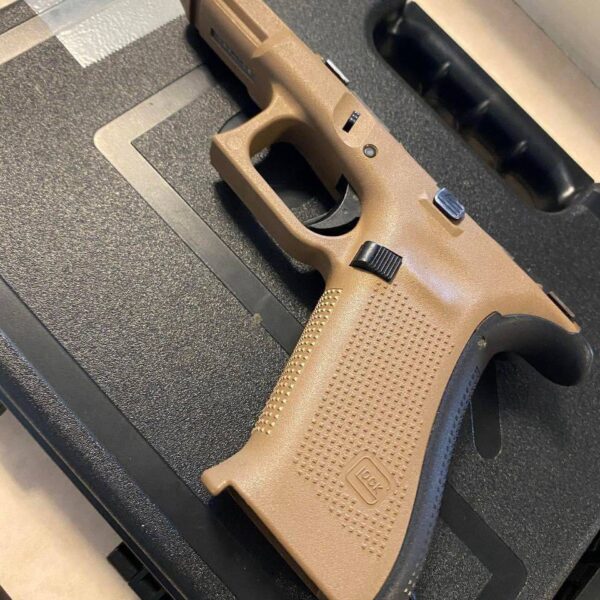
The Glock 23 Gen 3 uses a polymer frame paired with a metal slide and barrel. This construction gives the pistol its characteristic appearance and distinguishes it from handguns built around traditional all-metal frames.
Its compact format places it between smaller subcompact handguns and larger service-pistol models. Consequently, the Glock 23 has often been considered a versatile member of the Glock lineup.
The frame incorporates molded grip texturing and finger grooves. These features provide a defined gripping surface, although the way they feel varies according to hand size and individual preference.
The slide contains the principal external markings and operates as part of the pistol’s semi-automatic action. The barrel and other internal components work together within the manufacturer’s design.
Nevertheless, the appearance of a particular firearm may differ according to its production history, market, finish, or previous ownership. Used examples should therefore be assessed individually rather than assumed to match every published photograph.
Third-Generation Grip Features
The Gen 3 Glock 23 is recognizable by its molded finger grooves and textured grip surfaces. These design elements were intended to provide a consistent gripping interface.
Grip comfort is subjective. Some users prefer molded finger grooves, whereas others find that a different grip profile better suits their hands. Accordingly, a general product description should avoid claiming that one grip design is universally comfortable.
The frame’s texture also contributes to the way the pistol feels during ordinary handling. However, grip design alone does not establish accuracy, reliability, or suitability for a particular individual.
When evaluating a firearm, users should follow applicable safety procedures and consider whether its dimensions and controls are appropriate for their needs. Qualified instruction can help establish safe handling habits.
The Safe Action Safety System
One of the Glock 23 Gen 3’s defining characteristics is the manufacturer’s Safe Action system. It uses three mechanical safeties designed to work together as part of the trigger and firing mechanism.
The system is intended to help prevent unintended firing under specified conditions. However, it should not be interpreted as making the firearm incapable of discharging accidentally or through improper handling.
Trigger safety
The trigger safety is a small lever integrated into the trigger. It helps prevent the trigger from moving rearward unless the lever is properly depressed as part of normal trigger operation.
Firing pin safety
The firing pin safety is an internal mechanical block. It is designed to prevent the firing pin from moving forward to strike a cartridge primer until the trigger mechanism operates as intended.
Drop safety
The drop safety is part of the internal trigger mechanism. It helps prevent the firing pin from being released unintentionally if the pistol experiences a drop or similar impact.
Together, these features form the Safe Action system. Their proper operation depends on the firearm being maintained in accordance with the manufacturer’s instructions.
What Safe Action Does Not Mean
The term Safe Action describes a specific mechanical safety arrangement; it is not a guarantee against every possible accident.
A firearm can still discharge if its trigger is pressed, if it is mishandled, or if it has a mechanical fault. Therefore, the presence of multiple mechanical safeties does not eliminate the need for careful handling.
Owners should never rely solely on the trigger safety or internal mechanisms to prevent an unintended discharge. The firearm must be treated as loaded until its condition has been safely verified.
glock 23 pistol g23 gen 3 .40 caliber safe action
Furthermore, a firearm with an unfamiliar configuration or uncertain service history should receive appropriate professional inspection. Mechanical safeguards should never be assumed to be functional merely because the pistol appears undamaged.
Semi-Automatic Operating Principles
The Glock 23 Gen 3 is a semi-automatic pistol. In general terms, a semi-automatic firearm uses energy generated during firing to cycle its mechanism, extract and eject the fired cartridge case, and prepare the firearm for a subsequent shot.
The exact operation depends on the firearm’s design and condition. The Glock 23 uses a recoil-operated mechanism, with the slide and barrel interacting during the firing cycle.
This operating principle differs from that of a revolver, which uses a rotating cylinder to position cartridges or chambers for firing.
Understanding the general distinction helps readers identify the type of firearm described. However, any inspection, troubleshooting, or service involving internal operating components should follow the manufacturer’s documentation and, where necessary, be handled by a qualified gunsmith.
Dimensions and General Specifications
Published references commonly list the Glock 23 Gen 3 with an overall length of approximately 7.36 inches and a barrel length of approximately 4.01 inches. Its standard magazine capacity is commonly listed as 13 rounds, although applicable laws and specific configurations may differ.
These measurements provide a useful general reference, but they should not be treated as a substitute for official documentation. Specifications may vary by market or individual configuration.
The pistol’s compact dimensions distinguish it from larger models in the Glock range. However, measurements alone cannot establish whether a particular firearm is suitable for a person’s needs.
A complete technical description should identify the model and generation, chambering, dimensions, magazine configuration, and relevant manufacturer information. Any uncertainty should be clearly noted.
Comparing the Glock 23 and Glock 19
The Glock 23 and Glock 19 have similar general formats, but their principal distinction is their chambering.
The Glock 23 Gen 3 is chambered in .40 S&W, whereas the Glock 19 Gen 3 is chambered in 9×19 mm. This difference affects ammunition compatibility and distinguishes the two models despite their comparable compact dimensions.
glock 23 pistol g23 gen 3 .40 caliber safe action glock 23 pistol g23 gen 3 .40 caliber safe action glock 23 pistol g23 gen 3 .40 caliber safe action glock 23 pistol g23 gen 3 .40 caliber safe action glock 23 pistol g23 gen 3 .40 caliber safe action glock 23 pistol g23 gen 3 .40 caliber safe action glock 23 pistol g23 gen 3 .40 caliber safe action glock 23 pistol g23 gen 3 .40 caliber safe action glock 23 pistol g23 gen 3 .40 caliber safe action glock 23 pistol g23 gen 3 .40 caliber safe action glock 23 pistol g23 gen 3 .40 caliber safe action.
The models should not be treated as interchangeable. Ammunition intended for one chambering must not be used in a firearm designed for another.
Other details, including magazine specifications and internal components, must be checked against the appropriate model documentation. A shared appearance does not establish universal parts compatibility.
When comparing the two pistols, reliable manufacturer specifications provide a better foundation than assumptions based on their external resemblance.
Magazine and Ammunition Information
The magazine is a separate component that holds ammunition for use in the firearm. The Glock 23 Gen 3 is commonly associated with a standard 13-round magazine, subject to the particular configuration and local legal requirements.
Magazine compatibility should be verified through manufacturer documentation. Similar-looking magazines may differ in dimensions, capacity, or compatibility with particular models.
Ammunition should also match the firearm’s marked chambering. For this model, that means the correct .40 S&W cartridge, subject to the manufacturer’s requirements.
Owners should follow the instructions supplied with both the firearm and ammunition. They should also comply with all applicable storage, transport, possession, and capacity restrictions.
Accessory Rail and External Features
The third-generation Glock 23 incorporates an accessory rail on the frame. This feature distinguishes the model from some earlier Glock configurations.
An accessory rail is a mounting interface, not a guarantee that every accessory will fit. Compatibility depends on the accessory’s dimensions, design, and the manufacturer’s specifications.
glock 23 pistol g23 gen 3 .40 caliber safe action
The firearm’s external controls and markings also provide useful identification information. However, accessories, aftermarket parts, or refinishing can change the appearance of an individual pistol.
Consequently, the external appearance of a used example should not be treated as conclusive evidence of its original factory configuration.
Maintenance and General Care
Regular care helps preserve the condition of a firearm. Glock owners should consult the official owner’s manual for the maintenance procedures, approved products, inspection guidance, and lubrication requirements applicable to their model.
Before maintenance begins, the firearm must be handled according to the manufacturer’s unloading and safety instructions. Ammunition should be kept separate from the maintenance area.
The exterior should be inspected for obvious signs of damage, corrosion, or unusual wear. Any concerns involving the internal mechanism, trigger operation, or safety system should be evaluated by a qualified gunsmith.
Maintenance should not involve improvised modifications or unverified procedures. Furthermore, components should not be replaced with parts of uncertain compatibility.
If a firearm exhibits inconsistent operation or an unexplained mechanical change, it should not be used until the issue has been professionally assessed.
Evaluating a Used Glock 23 Gen 3
A used Glock 23 Gen 3 may differ from a new example in condition, configuration, and service history. Therefore, its present condition should be evaluated separately from the reputation of the model itself.
Buyers should verify the model markings and chambering. They should also review any available maintenance records and establish whether the firearm has undergone modifications.
External wear does not always reveal the condition of internal components. Similarly, a clean exterior does not guarantee that the mechanism or safety features function correctly.
A qualified gunsmith can assess the firearm’s condition and identify issues that are not readily apparent. Buyers should also confirm that any proposed purchase or transfer complies with applicable law.
When documentation is incomplete, it is better to acknowledge the uncertainty than to assume that the firearm retains every original factory component.
Safe Storage and Responsible Ownership
Safe storage is an essential part of firearm ownership. The Glock 23 Gen 3 should be secured against unauthorized access, particularly by children or anyone who has not been properly authorized and trained.
Storage arrangements should comply with local laws and the manufacturer’s guidance. Depending on the circumstances, a suitable locked container or approved secure storage system may be appropriate.
Ammunition should also be stored responsibly and protected from conditions that could damage it.
During handling, the firearm should be treated as loaded until its condition has been safely established. It should be pointed in a safe direction, and the trigger should not be touched unless the circumstances and training justify doing so.
These practices remain essential regardless of the model’s mechanical safety features.
Product Authenticity and Documentation
A product description or seller’s statement alone cannot establish that a firearm is authentic or that its components are original.
The model markings, available documentation, and physical condition should be considered together. Where questions remain, a qualified professional or authorized source can help verify the firearm’s identity and configuration.
glock 23 pistol g23 gen 3 .40 caliber safe action glock 23 pistol g23 gen 3 .40 caliber safe action glock 23 pistol g23 gen 3 .40 caliber safe action glock 23 pistol g23 gen 3 .40 caliber safe action glock 23 pistol g23 gen 3 .40 caliber safe action glock 23 pistol g23 gen 3 .40 caliber safe action glock 23 pistol g23 gen 3 .40 caliber safe action glock 23 pistol g23 gen 3 .40 caliber safe action glock 23 pistol g23 gen 3 .40 caliber safe action glock 23 pistol g23 gen 3 .40 caliber safe action glock 23 pistol g23 gen 3 .40 caliber safe action.
This is particularly important for used firearms advertised with special features or claims about their history.
Manufacturer documentation is also the most appropriate reference for confirmed specifications. Third-party descriptions may contain useful background information, but discrepancies should be resolved before being repeated as fact.
Frequently Asked Questions
What caliber is the Glock 23 Gen 3?
The Glock 23 Gen 3 is chambered in .40 S&W. Always verify the chambering marked on the individual firearm.
Is the Glock 23 Gen 3 a semi-automatic pistol?
Yes. It uses a striker-fired, semi-automatic operating system.
What is the Safe Action system?
It is Glock’s system of three mechanical safeties: the trigger safety, firing pin safety, and drop safety.
How long is the barrel?
Published specifications commonly list a barrel length of approximately 4.01 inches. Consult official documentation for the precise specification applicable to the particular firearm.
What is the standard magazine capacity?
The model is commonly listed with a 13-round standard magazine. Actual capacity and lawful magazine options depend on the configuration and applicable regulations.
Is the Glock 23 Gen 3 the same as the Glock 19 Gen 3?
No. Although their general formats are similar, the Glock 23 Gen 3 is chambered in .40 S&W, while the Glock 19 Gen 3 is chambered in 9×19 mm.
Does the Safe Action system eliminate the need for safe handling?
No. Mechanical safeties reduce certain risks but do not replace proper training, safe handling, secure storage, or professional maintenance.
Where can I find the official manual?
Consult Glock’s official owner’s resources and select the documentation appropriate to the model and generation.
Final Product Summary
The Glock 23 Gen 3 .40 caliber Safe Action pistol is a compact, polymer-framed, striker-fired handgun designed around the .40 S&W cartridge. Its third-generation features include molded grip texturing, finger grooves, and an accessory rail.
glock 23 pistol g23 gen 3 .40 caliber safe action glock 23 pistol g23 gen 3 .40 caliber safe action glock 23 pistol g23 gen 3 .40 caliber safe action glock 23 pistol g23 gen 3 .40 caliber safe action glock 23 pistol g23 gen 3 .40 caliber safe action glock 23 pistol g23 gen 3 .40 caliber safe action glock 23 pistol g23 gen 3 .40 caliber safe action glock 23 pistol g23 gen 3 .40 caliber safe action glock 23 pistol g23 gen 3 .40 caliber safe action.
The Safe Action system combines a trigger safety, firing pin safety, and drop safety to provide multiple mechanical safeguards. Nevertheless, the firearm must always be handled responsibly, maintained according to the manufacturer’s instructions, and stored securely.
Accurate product information should distinguish verified specifications from assumptions about a particular firearm’s history or condition. For technical details, maintenance procedures, and model-specific guidance, the manufacturer’s documentation remains the primary reference.
Publication note: This expansion is intended as general product information. Confirm all specifications against the official documentation for the exact Glock 23 Gen 3 configuration before using the text in a commercial listing.

Reviews
There are no reviews yet.